



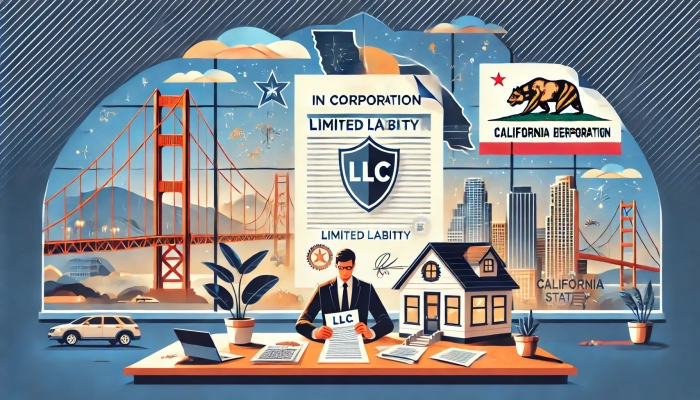
Setting up a limited liability company (LLC) or a corporation in California can offer several benefits for business owners. One of the primary benefits of forming an LLC or corporation is limited liability protection. Both LLCs and corporations are separate legal entities from their owners, which means that the owners (known as members in an LLC and shareholders in a corporation) are generally not personally responsible for the company’s debts or legal liabilities.[i] Instead, the liability of the owners is limited to their investment in the company. This protection can provide a significant level of security for business owners, especially in industries where there is a higher risk of lawsuits or other legal disputes.
However, just forming an LLC or corporation does not automatically provide limited liability protection. In order for limited liability to exist, the business owner must operate their LLC or corporation correctly so that the corporate veil that provides the limited liability is not pierced. In this article, we will explore the concept of piercing the corporate veil in more detail, including its legal basis, the circumstances under which it may be applied, and its practical implications for various parties.
-
What is a Corporate Veil?
The corporate veil is a legal concept that separates the identity of a corporation from that of its owners, protecting them from personal liability for the corporation’s debts and obligations. In other words, the corporate veil shields the personal assets of the company’s shareholders, officers, and directors from being used to pay the company’s debts, lawsuits, or other legal obligations.
However, the corporate veil can be pierced or lifted under certain circumstances. When this happens, the court may hold the owners personally liable for the corporation’s debts and other obligations, thereby disregarding the corporate veil.
-
How can the Corporate Veil be pierced?
Piercing the corporate veil in California is a legal process in which a court allows plaintiffs to hold the shareholders or owners (or in the case of LLCs, its members) of a corporation personally liable for the corporation’s debts and obligations. Note, the courts are cautious when considering piercing the corporate veil, because the courts generally want to preserve the advantage provided by an entity’s corporate form to maintain predictability under the law.
The primary theory used for piercing the corporate veil is Alter Ego liability. Under the theory of Alter Ego liability, a court may pierce the corporate veil if both parts of the following two-part test is met:
- The corporation and its shareholders have a unity of interest in that they have no real separate existence; and
- The corporation’s acts should be treated as the shareholders’ acts to avoid an inequitable result.[ii]
For example, plaintiffs may show that an inequitable result would occur if the corporation and its shareholders are treated as separate entities by providing evidence of either:
- Injustice flowing from treating the corporation and shareholders separately.
- Wrongdoing or conduct amounting to bad faith, making it inequitable for the shareholders to hide behind the corporate form.
The Alter Ego doctrine does not require plaintiffs to show that a corporation’s shareholders acted fraudulently or with wrongful intent to avoid a debt. California law only requires a showing that maintaining the corporation’s separate existence would lead to an injustice or inequitable result.[iii]
While there are no specific set of facts or circumstances that satisfies the two-part test that requires piercing the corporate veil, the court will look at the following circumstances or facts:
- A single shareholder owning all of the corporation’s shares.
- A shareholder controlling the corporation.
- A shareholder using the same office or business location as the corporation.
- A shareholder commingling its assets and property with those of the corporation, including:
- funds;
- bank accounts; and
- corporate records, including minutes.
- A corporation or shareholder holding out to the public that the shareholder is:
- personally liable for the corporation’s debts;
- using the corporation’s funds to pay the shareholder’s debts; or
- otherwise using the corporation’s assets as the shareholder’s own.
- A corporation failing to maintain adequate corporate records, such as:
- keeping minutes;
- electing directors; and
- appointing officers.
- A corporation otherwise disregarding corporate formalities.
- A corporation and its shareholder having identical:
- directors and officers;
- legal counsel (representing both the shareholder and the corporation); or
- employees or a combined payroll.
- A corporation lacking assets or being inadequately capitalized.
- A shareholder using the corporation as a mere shell or instrumentality for the shareholder’s business.
- A shareholder acting as a significant supplier of labor or materials to the corporation.
- A shareholder failing, on incorporating the corporation, to:
- contribute capital, issue shares, or apply for necessary permits; or
- complete formation of the corporation.
-
Alter Ego Liability for Joint Enterprises
Alter Ego liability may also arise where two corporations (brother-sister corporations) are under the common ownership of a third entity. This is known as the single enterprise or joint enterprise doctrine. If the court determines that the two corporations and their common owner constitutes a single enterprise, the entire enterprise is liable for the acts and omissions of each component entity in the enterprise.[iv]
A California court may pierce the corporate veil of a sister corporation if both:
- The degree of unity of interest and ownership among all the entities makes the separate corporate personalities merged so that, in practice, the entities form a single enterprise.
- An inequitable result would follow if the acts in question were treated as the acts of one component entity only.[v]
Factors to finding a single enterprise are similar to the circumstances stated earlier, but also include:
- Commingling of funds and assets of the component entities, such as using one component entity’s funds or assets to pay for or guaranty another component entity’s obligations.
- Having identical equity ownership.
- Having the same directors and officers.
- Using the same offices and employees.
- Disregarding corporate formalities between the component entities.
- Using one component entity as a mere shell or conduit for another’s affairs.[vi]
-
[i] Maxwell Cafe, Inc. v. Dep’t of Alcoholic Beverage Control, 142 Cal.App.2d 73, 78 (1956) and Grosset v. Wenaas, 42 Cal.4th 1100, 1108 (2008).
[ii] Automotriz del Golfo de Cal. S. A. de C. V. v. Resnick, 47 Cal.2d 792, 796 (1957) and Hasso v. Hapke, 227 Cal.App.4th 107, 155 (2014), as modified on denial of reh’g (July 15, 2014), review denied (Oct. 22, 2014).
[iii] Misik v. D’Arco, 197 Cal.App.4th 1065, 1074 (2011), as modified (Aug. 9, 2011)).
[iv] Gopal v. Kaiser Found. Health Plan, Inc., 248 Cal.App.4th 425, 431 (2016), as modified (June 23, 2016).
[v] Id at 432 and Mou v. SSC San Jose Operating Company LP, 415 F. Supp. 3d 918, 930-931 (N.D. Cal. 2019).
[vi] Toho-Towa Co. v. Morgan Creek Prods., Inc., 217 Cal.App.4th 1096, 1108-09 (2013) and Las Palmas Assocs. v. Las Palmas Ctr. Assocs., 235 Cal.App.3d 1220, 1250-51 (1991).
Comments are closed.